
As an Amazon Associate I earn from qualifying purchases.
You need speakers that reveal the truth in your mix, not flatter it. Cheap multimedia speakers color the sound, hiding flaws that will show up on other systems.
What matters is flat frequency response, clear stereo imaging, and enough power for your room. Size, inputs, and tuning controls also play a role depending on your setup.
We picked five studio monitors that cover different budgets and needs, from compact desktop pairs to larger near-field models. Each excels in its category without overlap.
Our Top 5 Studio Monitors Picks at a Glance
| Product | ||
|---|---|---|
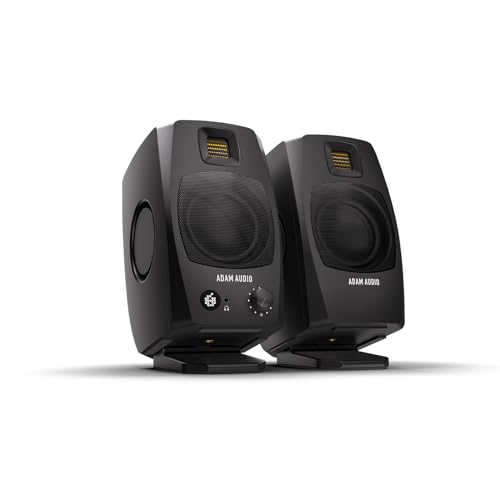 |
ADAM Audio D3V Active Desktop Studio Monitor Premium desktop accuracy |
Check Price |
 |
KRK RP5G5 ROKIT 5 Generation 5 Balanced near-field performance |
Check Price |
 |
PreSonus Eris E4.5 2-Way 4.5" Near Field Budget-friendly near-field clarity |
Check Price |
 |
PreSonus Eris 3.5 Powered Studio Monitors Compact desktop monitoring |
Check Price |
 |
Mackie CR3.5 Studio Monitors Simple, honest sound |
Check Price |
Top 5 Studio Monitors: Detailed Reviews
1. ADAM Audio D3V Active Desktop Studio Monitor
The ADAM Audio D3V is a compact active Studio Monitor designed for desktop use, delivering pro-grade clarity with its D-ART tweeter and DSP tuning. The 3.5” aluminum woofers and passive radiators extend the low-end response, while the 1.5” D-ART tweeter ensures precise high-frequency reproduction. Balanced TRS inputs and placement-optimizing DSP switches address acoustic issues, and the detachable angled stands improve listening alignment.
What We Like:
- D-ART tweeter provides clear, fatigue-free highs for accurate mixing
- DSP tuning compensates for desk placement issues
- Detachable angled stands improve stereo imaging
- Balanced TRS inputs ensure clean signal transmission
- Auto sleep mode can be toggled for energy savings
What Could Be Improved:
- Small 3.5” woofers limit deep bass extension
- USB-C connectivity may not suit all setups
This Studio Monitor suits producers and songwriters needing precise sound in tight spaces. Skip it if you require deeper bass or larger drivers for room-scale monitoring.
2. KRK RP5G5 ROKIT 5 Generation 5
The KRK RP5G5 ROKIT 5 Generation Five is a Studio Monitor built for balanced near-field performance, featuring 5" woofers and Class D amps that deliver punchy, clear sound with minimal distortion. The silk dome tweeter sharpens high frequencies, while the low diffraction baffle reduces edge diffraction for better stereo imaging. Isolation pads cut resonance, and the combo XLR/TRS input ensures compatibility with most gear.
What We Like:
- Class D amps provide efficient, cool-running power with clean audio integrity
- Silk dome tweeter improves high-mid and high-frequency clarity
- Low diffraction baffle reduces distortion for accurate stereo imaging
- Isolation pads minimize resonance and aid proper positioning
- XLR and 1/4” TRS inputs work with a wide range of audio devices
What Could Be Improved:
- Bass response may feel limited in larger rooms
- No built-in room correction features
Buy this if you need a reliable Studio Monitor for near-field mixing or production in a small to medium space. Skip it if you require deep bass or advanced room tuning for larger studios.
3. PreSonus Eris E4.5 2-Way 4.5" Near Field
The PreSonus Eris E4.5 is a pair of active near-field Studio Monitor speakers designed for accurate sound in small spaces. Its 4.5-inch woven-composite woofers deliver tight, punchy bass, while 50W of Class AB amplification ensures clear, balanced audio at any volume. The 1-inch silk-dome tweeters provide a wide sweet spot, so you get consistent stereo imaging even if you move around. Front and rear inputs make it easy to connect professional or consumer gear.
What We Like:
- Woven-composite woofers produce tight, controlled bass for a small speaker
- 50W Class AB amps deliver strong, distortion-free sound
- Wide sweet spot means consistent audio from different angles
- Front-panel aux input adds convenience for quick connections
- Tuning controls let you adjust high and low frequencies to your room
What Could Be Improved:
- Bass response may lack depth for larger rooms
- Plastic build feels less premium than higher-end monitors
Buy the Eris E4.5 if you need accurate, balanced sound in a compact Studio Monitor for small studios or desks. Skip it if you need deeper bass or a more rugged build for heavy use.
4. PreSonus Eris 3.5 Powered Studio Monitors
The PreSonus Eris 3.5 is a pair of compact Studio Monitor speakers designed for small desks and tight spaces. With 3.5” woven-composite woofers and 1” silk-dome tweeters, they deliver a balanced 80 Hz–20 kHz response that’s clear enough for mixing or casual listening. The built-in 50-watt amp keeps distortion low even at higher volumes, while room tuning controls let you adjust high and low frequencies to compensate for your space without extra gear. Inputs include TRS, RCA, and a front aux jack for easy connections to most devices.
What We Like:
- Compact size fits neatly on a desk without sacrificing clarity
- Room tuning controls help adapt the sound to untreated spaces
- Multiple input options work with computers, interfaces, and consumer devices
- 50-watt amplification provides clean, distortion-free sound at moderate volumes
- Silk-dome tweeters reduce harshness for smoother highs
What Could Be Improved:
- Bass response is limited by the small 3.5” woofers
- Not ideal for larger rooms or high-volume listening
Buy the Eris 3.5 if you need a space-saving Studio Monitor for a small desk or untreated room. Skip it if you need deeper bass or higher output for larger spaces.
5. Mackie CR3.5 Studio Monitors
The Mackie CR3.5 Studio Monitors are a pair of compact, powered speakers designed for desks and small studios. The Tone Knob lets you adjust voicing on the fly, while the Location Switch tweaks bass response based on placement, so you get honest sound whether they’re against a wall or free-standing. They come with isolation pads and all necessary cables, making setup straightforward for accurate monitoring right out of the box.
What We Like:
- Sold as a pair, ready for stereo monitoring
- Tone Knob simplifies voicing adjustments without menus
- Location Switch compensates for bass based on placement
- Includes isolation pads and cables for immediate use
What Could Be Improved:
- 3.5-inch woofers limit low-end extension
- Not ideal for larger rooms or high SPL needs
These are great for small spaces or beginners who need simple, honest sound and easy setup. Skip them if you need deeper bass or higher volume for larger studios.
How to Choose the Right Studio Monitor
A Studio Monitor should match your space and workflow. Room size dictates driver size—larger rooms benefit from 5-inch or bigger woofers, while small desks suit 3.5 to 4.5-inch models. Near-field monitors work best when placed close to you, reducing room reflections that color sound.
Frequency response
Look for a flat frequency response across the range you need. A wider response captures more detail, but a balanced midrange is critical for mixing. Avoid monitors with hyped bass or treble, as they mask flaws in your work.
Power and connectivity
Active monitors have built-in amplification, simplifying setup. Check inputs—XLR and TRS are standard, but RCA may suit home studios. Ensure power output matches your listening level; underpowered monitors distort at high volumes.
Build and placement
Durable cabinets reduce resonance, while front-ported designs allow flexible placement. If your desk is against a wall, rear-ported monitors may cause bass buildup. Isolation pads can help, but ideal positioning is key.
Which Studio Monitor Fits Your Setup
The ADAM Audio D3V delivers the most accurate sound for serious work, with clarity that justifies its premium price. If you need a balanced alternative, the KRK RP5G5 offers near-field performance at a lower cost. Both outperform the rest in precision, making them the top choices for critical listening.

Hi, I’m Tom Scalisi, and welcome to The Saw Blog! I started this blog to share my hands-on experience and insights about woodworking tools—especially saws and saw blades. Over the years, I’ve had the chance to work with a wide range of tools, and I’m here to help both professionals and hobbyists make informed decisions when it comes to selecting and using their equipment. Whether you’re looking for in-depth reviews, tips, or just advice on how to get the best performance out of your tools, you’ll find it here. I’m excited to be part of your woodworking journey!