
As an Amazon Associate I earn from qualifying purchases.
The right screen can make a projector setup feel polished, but the wrong format can create storage problems, setup hassles, or a poor fit for your room. You need to balance image size with mounting style, portability, and how often you plan to use it.
When choosing a Home Cinema Projector Screen, pay attention to the screen surface, gain, viewing angle, frame or stand design, and whether it supports front or rear projection. Motorized and floor-rising models can save effort, while foldable screens are easier to store and carry.
These five picks were selected from the listed features to cover fixed-frame home theaters, automated installations, outdoor viewing, and portable use. They also vary in design and size rather than repeating simple colour or size alternatives.
This guide compares what sets each screen apart, then outlines the main buying considerations so you can choose a model that suits your projector and viewing space.
Our Top 5 Home Cinema Projector Screen Picks at a Glance
| Product | ||
|---|---|---|
 |
Silver Ticket STR Series 120-Inch Fixed Frame Dedicated home theaters |
Check Price |
 |
Elite Screens Spectrum RC1 125-Inch Motorized Convenient wall or ceiling installs |
Check Price |
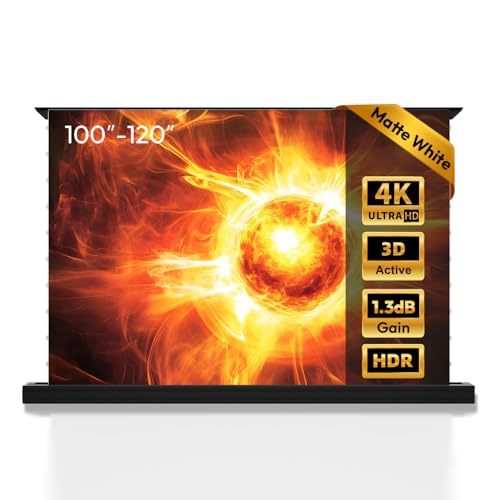 |
NothingProjector 100-Inch Motorized Floor Rising Flexible premium installations |
Check Price |
 |
ZUVMITG 120-Inch Projector Screen With Stand Stable outdoor movie nights |
Check Price |
 |
Mdbebbron 120-Inch Foldable Projector Screen Portable indoor or outdoor viewing |
Check Price |
Top 5 Home Cinema Projector Screen: Detailed Picks
1. Silver Ticket STR Series 120-Inch Fixed Frame
The Silver Ticket STR Series is a fixed-frame Home Cinema Projector Screen for a permanent wall-mounted setup. Its 120-inch, 16:9 viewing area uses a 1.1-gain white surface with a 160-degree viewing angle, so people seated across the room can watch without resolution loss. The heavy-duty beveled aluminum frame has a light-absorbing black velvet border that helps the image look crisp. Tensioning rods support assembly, while the screen works with long-, short-, and ultra-short-throw projectors, though some UST models are incompatible.
What We Like:
- The 160-degree viewing angle suits wide seating arrangements.
- The black velvet border absorbs light around the image area.
- The aluminum frame provides a clean, permanent cinema-style finish.
- The tensioning rod system makes assembly straightforward.
- It supports Full HD, 4K, and 8K content.
What Could Be Improved:
- There is no option for legs or a stand, so you need a suitable wall installation.
- Some ultra-short-throw projectors are incompatible with this STR frame.
- You should project an image on your wall first to confirm the size suits your projector.
Buy this screen if you are building a dedicated home theater and want a large, permanently mounted display with a wide viewing angle. Skip it if you need portability, a freestanding setup, or guaranteed compatibility with an ultra-short-throw projector; Silver Ticket recommends its S7 frame series for some UST models.
2. Elite Screens Spectrum RC1 125-Inch Motorized
The Elite Screens Spectrum RC1 is a 125-inch Home Cinema Projector Screen for a dedicated wall or ceiling installation. Its 16:9 format provides a 61.3-by-109-inch viewing area, while the fully assembled motorized design makes setup more straightforward. IR and RF remotes let you control the screen from different positions, and you can program its vertical drop. MaxWhite 2 material has 1.1 gain, a 180-degree viewing angle, and support for 4K, 8K, and active 3D projection. The included kit also supports a wired 12-volt trigger, but it is not compatible with short-throw projectors.
What We Like:
- The 125-inch image suits dedicated home theater rooms.
- IR and RF remotes give you flexible screen control.
- The programmable drop position helps match the screen to your room.
- The 180-degree viewing angle works well for groups seated across the room.
- The included wall or ceiling installation kit simplifies mounting.
What Could Be Improved:
- It cannot be used with short-throw or ultra-short-throw projectors.
- Its 74.5-by-120.5-inch overall size requires substantial wall or ceiling space.
- A motorized screen needs a suitable installation location and power arrangement.
Buy it if you want a large, permanently installed screen with convenient remote operation and broad seating compatibility. It suits dedicated movie rooms and compatible standard-throw projectors. Skip it if you use a short-throw model, lack enough mounting space, or need a portable screen for changing locations.
3. NothingProjector 100-Inch Motorized Floor Rising
The NothingProjector Motorized Floor Rising Screen is a 100-inch Home Cinema Projector Screen for flexible premium installations. Its matte white PVC surface has 1.3 gain, supporting brighter images with 4K/8K UHD and active 3D projectors. Full black backing blocks light penetration, while the 170° viewing angle helps maintain consistent images across seating positions. A USB trigger can raise the screen when your projector starts and retract it when the projector powers down. The quiet DC motor adds soft-start and soft-stop operation, with position memory, reset, and overheat protection.
What We Like:
- USB projector sync makes one-touch viewing convenient.
- Black backing helps prevent light from passing through the screen.
- The 170° viewing angle suits rooms with wider seating.
- The quiet motor is less distracting during operation.
- It supports UST, short-throw, and standard projectors.
What Could Be Improved:
- A floor-rising design needs clear floor space in front of the viewing area.
- Its automatic controls depend on a compatible USB connection and powered setup.
- The 100-inch format may be too large for smaller rooms.
Buy it if you want a clean, retractable screen for a dedicated or flexible viewing space and value automatic projector syncing. It suits mixed projector setups, including UST and short-throw models. Skip it if you need a portable screen, have limited floor clearance, or prefer a permanently mounted frame.
4. ZUVMITG 120-Inch Projector Screen With Stand
The ZUVMITG 120-inch Projector Screen with Stand is a Home Cinema Projector Screen designed for outdoor movie nights and flexible indoor viewing. Its reinforced base and strong support frame provide a steadier platform, while four ground stakes and two ropes help secure it outdoors. The washable milk silk fabric is designed for vibrant 4K HD visuals, and the 160° viewing angle supports clear front- and rear-facing images. A carry bag makes transport easier, while the tool-free assembly and straightforward instructions simplify setup.
What We Like:
- The reinforced base helps reduce wobbling during viewing.
- Included stakes and ropes add useful wind protection outdoors.
- The 160° viewing angle supports front and rear projection.
- The washable milk silk fabric is designed for vivid 4K HD images.
- The carry bag and tool-free setup suit camping and road trips.
What Could Be Improved:
- A 120-inch screen needs substantial room indoors or outdoors.
- Outdoor stability still depends on securing the stakes and ropes properly.
- The stand, screen, and windproof accessories may take more setup than a smaller portable screen.
Buy it if you want a large, portable screen for backyard films, camping, or indoor events and value a reinforced stand with outdoor securing accessories. Skip it if you have limited space or prefer a compact screen that requires less assembly and fewer components to transport.
5. Mdbebbron 120-Inch Foldable Projector Screen
The Mdbebbron Home Cinema Projector Screen is a 120-inch, 16:9 foldable fabric screen for portable indoor or outdoor viewing. Its 105-by-59-inch viewing area gives movies and presentations plenty of scale, while the lightweight one-piece design folds into a backpack or suitcase. Polyester fabric is described as smooth, thicker, anti-crease and high-absorbance for sharper, brighter projection. You can mount it with hooks, ropes, brackets, nails or double-sided tape, and support for front or rear projection adds flexibility when room layout or outdoor placement changes.
What We Like:
- The lightweight fabric folds compactly for storage and travel.
- The 120-inch diagonal creates an expansive viewing area for group movie nights.
- Front and rear projection support makes placement more adaptable.
- A 160-degree viewing angle helps viewers see the image from different seats.
- It suits home movies, presentations, education and outdoor screenings.
What Could Be Improved:
- A foldable fabric screen needs suitable attachment points and careful mounting, unlike a rigid framed model.
- Although the material is designed to resist creasing, folding can still make setup less immediately tidy than using a permanently mounted screen.
- The screen itself provides flexibility, but it does not offer the rigid, tensioned presentation of a fixed-frame design.
Buy it if you need a large screen that stores easily and works across indoor, outdoor, front-projection and rear-projection setups. Skip it if you want a permanently taut surface, a fixed installation or the simplest possible setup without finding mounting points.
How To Choose A Home Cinema Projector Screen
Choosing a Home Cinema Projector Screen
The right Home Cinema Projector Screen depends first on where you watch and how permanent the setup should be. A fixed-frame screen suits a dedicated room because it stays tensioned and ready for use, while a motorized model can disappear when you want the wall or ceiling clear. Portable designs make more sense if you move the screen between rooms or take it outdoors.
Match the screen to your room
Measure the available wall, ceiling, or floor area before choosing a screen size. A larger image is not automatically better if it overwhelms the room or leaves little space around the frame. Consider seating distance, viewing angle, and whether the screen will sit at a comfortable height for everyone. Outdoor viewing also needs enough clear space for the screen, stand, projector, and audience.
Choose the installation style
Fixed-frame screens require a more committed installation, but they offer a tidy, theatre-like presentation once mounted. Motorized screens are useful when you want to raise or lower the viewing surface as needed, though they require a suitable wall or ceiling position and access to power. Floor-rising screens avoid permanent mounting and can work well in premium setups where flexibility matters, but you still need a stable, unobstructed area for deployment.
Think about stability and portability
A stand-based screen can be practical outdoors, but stability becomes more important on grass, patios, or other uneven surfaces. Check that the setup has enough room and support to remain upright during use. Foldable screens are easier to store and transport, making them useful for occasional indoor or outdoor movie nights, but they may involve more setup each time than a permanently installed screen.
Finally, decide how often you will use the screen. Frequent movie nights reward quick deployment or a permanently ready installation, while occasional viewing may justify a foldable or floor-rising design. Prioritise the screen format that fits your room and routine rather than choosing by size alone.
Which Home Cinema Projector Screen Should You Choose?
The Silver Ticket STR Series 120-Inch Fixed Frame is the best overall pick for a dedicated home theatre, where a permanent, cinema-style setup makes sense. The Elite Screens Spectrum RC1 125-Inch Motorized is the best alternative if you want easier wall or ceiling installation and the ability to put the screen away between viewings. Both choices fit distinct routines: committed viewing versus convenient everyday flexibility.

Hi, I’m Tom Scalisi, and welcome to The Saw Blog! I started this blog to share my hands-on experience and insights about woodworking tools—especially saws and saw blades. Over the years, I’ve had the chance to work with a wide range of tools, and I’m here to help both professionals and hobbyists make informed decisions when it comes to selecting and using their equipment. Whether you’re looking for in-depth reviews, tips, or just advice on how to get the best performance out of your tools, you’ll find it here. I’m excited to be part of your woodworking journey!