
Ever feel like your computer is holding back your music-making dreams? Maybe you’ve tried recording a song, and it sputtered and crashed. Or perhaps you’re just starting out, and the sheer number of computer choices feels overwhelming. Picking the right desktop computer for music production can be a real headache. You want something powerful enough to handle your ideas, but not so expensive that it breaks the bank. It’s a tricky balance to strike!
But don’t worry, you’re not alone in this. This post is here to guide you through the maze. We’ll break down what really matters when choosing a music desktop, so you can stop stressing and start creating. By the end of this article, you’ll have a clearer idea of what to look for, helping you find a computer that will be your perfect musical partner.
Top Desktop For Music Recommendations

- 【Designed for Music Creators】Built specifically for music production, recording, mixing, podcasting, streaming, and content creation. This music studio desk creates an organized workspace where creativity flows without distractions.
- 【Sliding Keyboard Tray for 88-Key MIDI Keyboards】The spacious pull-out keyboard tray keeps your MIDI keyboard within easy reach while maximizing desktop space. Perfect for music producers, composers, and recording artists.
- 【Professional Studio Organization】Featuring a built-in pegboard side panel and headphone hook, this recording studio desk helps keep headphones, cables, accessories, and studio essentials neatly organized and accessible.

- 【SMALL HIFI BOOKSHELF SPEAKERS】With its modern aesthetic and compact design, this stylish black speaker complements contemporary home or office décor. The space-saving design fits seamlessly into any environment, maximizing desktop space. Ideal for desktop setups or small room audio systems like home offices or gaming stations.
- 【Experience powerful sound】Unleash powerful 30Wx2 distortion-free sound. Featuring a 0.75-inch carbon fiber silk dome tweeter and a 3-inch carbon fiber full-range driver, this speaker delivers crystal-clear highs and rich mid-bass. The rear bass port amplifies low-end depth, while the integrated independent sound card ensures smooth, detailed audio playback for the ultimate listening experience.
- 【Durable Performance】Built with a premium MDF wooden enclosure, this computer speakers effectively reduces box resonance for clearer, stream studio-quality,more precise sound. The easy-to-reach volume control knob on the front panel allows for quick adjustments during gaming or music sessions. Crafted from high-quality materials, it’s designed for long-lasting durability, providing consistent, stable performance even during intense gaming use.
- 【SPACIOUS & SECURE HOLDING TRAY】 Our deep 2-inch tray comfortably accommodates thick music books and binders. Features reinforced, high-tension spring arms to firmly grip sheet music, tablets, or even a lightweight laptop, ensuring they stay perfectly in place during intense performances.
- 【FULL 180° ANGLE ADJUSTMENT】 Tilt the tray to any angle from completely flat to fully upright for the ideal viewing position. Engineered with smooth-turning knobs that allow for quick, precise, and secure adjustments on the fly, right in the middle of your practice or gig.
- 【EXTENDED HEIGHT RANGE FOR ALL MUSICIANS】 With a wide height adjustment range from 35 inches to 55 inches, this stand is perfect for both seated and standing use. The ultimate versatile solution for guitarists, pianists, violinists, drummers, and saxophone players.

- TRUSTED STUDIO-QUALITY SOUND: True studio sound for music production, gaming, movies, streaming, and everyday audio. Sold as a complete stereo pair.
- POWERFUL, DISTORTION-FREE SOUND: 50 watts of built-in amplification drives clear, dynamic sound at any volume — powerful enough to fill the room, clean enough to hear every detail.
- ACCURATE, POWERFUL SOUND: 3.5” woven-composite woofers deliver deeper, tighter bass while 1” silk-dome tweeters smooth out harshness for clear, balanced highs across the full range (80 Hz–20 kHz).
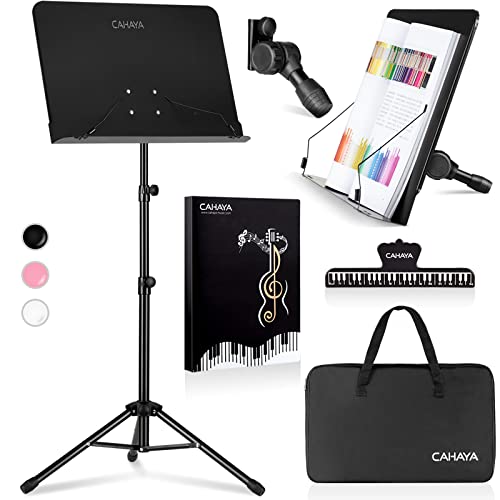
- SPACIOUS TRAY WITH SECURE HOLD – 2" deep tray fits thick music books; reinforced spring arms secure sheet music, tablets, or a lightweight laptop to prevent slipping.
- FULLY ADJUSTABLE VIEWING ANGLE – Tray tilts up to 180° for flat or angled viewing; smooth knobs enable quick, precise adjustments on stage or in practice.
- HEIGHT FOR EVERY SITUATION – Adjusts from 31.4" to 57" for seated or standing use; versatile for guitarists, violinists, drummers, saxophonists, and more.

- Great for Body Health: The document holder is adjustable with 7 position at the backstand to adjust height and angle to make you easily reading without straining your back, shoulders or neck, then you can enjoy reading books while promoting a proper posture and even improve the spinal health.
- HIGH PRACTICAL: Design with Highlighting Line Guide makes you're easier to see where you left off and keep your track while typing, reading or transcribing. Comes with page holder clip to ensure documents do not slide. Help you work more efficiently.
- Really Sturdy & Stable: The bottom is designed with a page support clip to keep the book open on the page you need to read. The metal backplate, easily supports your documents. Very sturdy and can withstand multiple sizes of papers, recipes, books, magazines, textbooks and catalogs.

- 【FULLY ADJUSTABLE PERFORMANCE STAND】 Customize your setup with height adjustment from 26.4" to 52.7" and 180-degree bookplate tilting. Find the perfect viewing angle whether sitting or standing. The innovative design accommodates musicians of all heights and playing positions, making it ideal for practice, rehearsals, and live performances.
- 【HEAVY-DUTY METAL CONSTRUCTION】 Built with premium thickened metal tripod legs and reinforced joints, this stand delivers exceptional stability supporting up to 3 lbs of weight. Non-slip rubber feet provide a secure grip on any surface, eliminating wobble during performances. Designed to withstand daily use in both indoor and outdoor environments.
- 【ULTRA-LIGHTWEIGHT & PORTABLE】 Weighing just 1.8 lbs, this stand combines rugged durability with easy portability. The included carrying bag allows for instant storage without disassembly - simply fold and go. Perfect for musicians who need reliable equipment that moves as quickly as they do between classes, rehearsals, and gigs.

- Music Stand: Height support adjustment (between 29-54 inches) for seated and standing used; Innovative design supports switching between music stand and book stand
- Music Stand For Sheet Music: The sturdy 13.6-inch diameter tripod base with rubber feet easily holds up to 13 LB of weight; the 1.6-inch deep tray is large enough to hold any type of sheet music or book
- Music stand: Music Stand*1, Book Stand*1, 180° Adjustable Clip on Light, Carrying Case*1, Sheet Music Clip*1; With music stand light, easily covers two pages of sheet music; The stable light soure, protects your eyesight and reduces eye strain
Choosing Your Dream Desktop for Music Production
Making music on a computer is awesome! Whether you’re just starting or you’re a seasoned pro, having the right desktop computer makes a huge difference. This guide will help you pick the perfect machine for your musical adventures.
Key Features to Look For
When you’re buying a desktop for music, some things are super important.
1. Powerful Processor (CPU)
- Your CPU is like the brain of your computer. It handles all the heavy lifting for your music software.
- Look for Intel Core i5, i7, or i9 processors. AMD Ryzen 5, 7, or 9 are also great choices.
- More cores and faster speeds mean your computer can handle more tracks and effects without slowing down.
2. Plenty of RAM (Memory)
- RAM is where your computer stores information it’s actively using. For music, this means your audio samples, virtual instruments, and software.
- 8GB of RAM is the minimum you should consider.
- 16GB is much better for most home studios.
- 32GB or more is ideal if you use lots of virtual instruments or work with very large projects.
3. Fast Storage (SSD)
- You need a place to store your music files, software, and operating system.
- Solid State Drives (SSDs) are way faster than older Hard Disk Drives (HDDs).
- An SSD makes your computer boot up quickly and load your music programs and files in a flash.
- Consider getting a larger SSD for your main drive and maybe a secondary HDD for storing lots of audio files if you need more space.
4. Good Graphics Card (GPU) (Less Crucial for Music, but Helpful)
- While not as important as the CPU or RAM for music production, a decent graphics card can help if your music software has lots of visual elements or if you plan to do any video editing alongside your music.
- Most built-in graphics are fine, but a dedicated card can offer a smoother experience.
5. Connectivity (Ports)
- You’ll need ports to connect your microphones, instruments, speakers, and other gear.
- Look for plenty of USB ports (USB-A and USB-C).
- HDMI or DisplayPort for your monitor.
- Audio outputs are also important.
Important Materials and Build Quality
- Case: A sturdy metal case protects your computer’s insides. Good airflow is also key to keep things cool.
- Cooling System: Music production can make your computer work hard. A good cooling system (fans and heat sinks) prevents overheating and keeps your computer running smoothly.
Factors That Improve or Reduce Quality
- Improve Quality:
- Faster Processor: Handles more complex tasks.
- More RAM: Allows for more simultaneous operations.
- SSD Storage: Speeds up loading and saving.
- Efficient Cooling: Prevents performance drops due to heat.
- Reduce Quality:
- Slow Processor: Causes lagging and audio dropouts.
- Not Enough RAM: Limits what you can do at once.
- HDD Storage for Main Drive: Slows down everything.
- Overheating: Can damage components and cause crashes.
User Experience and Use Cases
- Beginner Home Studio: A desktop with a decent CPU, 8-16GB RAM, and an SSD is perfect for learning, recording vocals, and using basic virtual instruments.
- Intermediate Producer: Needs more power. 16-32GB RAM, a faster CPU, and a good amount of SSD storage let you use more complex virtual instruments, plugins, and handle larger projects.
- Professional Studio: Requires top-tier performance. High-end CPUs, 32GB+ RAM, large SSDs, and excellent cooling are essential for demanding tasks like mixing large orchestras or complex electronic music.
- Live Performance: A stable and reliable desktop with fast boot times and good processing power is crucial for running backing tracks, virtual instruments, and effects on stage.
Desktop for Music: Frequently Asked Questions
Q: What is the most important part of a desktop for music?
A: The most important parts are the processor (CPU) and the RAM (memory). They control how fast your computer can work with your music software.
Q: How much RAM do I really need?
A: For music, 16GB of RAM is a great starting point. If you plan to use many virtual instruments or large projects, 32GB is even better.
Q: Should I get an SSD or an HDD?
A: You should definitely get an SSD for your main drive. It makes your computer much faster. You can use an HDD for extra storage if you need more space for files.
Q: Do I need a fancy graphics card for music?
A: Not usually. Most music production tasks don’t need a powerful graphics card. Your computer’s built-in graphics are often enough.
Q: What does “core count” mean for a CPU?
A: Cores are like mini-brains within your CPU. More cores mean your computer can do more things at the same time, which is great for music production.
Q: How can I make sure my desktop doesn’t get too hot?
A: Look for a desktop with good cooling systems, like plenty of fans and good airflow. Keeping your computer clean also helps.
Q: Can I upgrade my desktop later if I need more power?
A: Yes, many desktops allow you to upgrade components like RAM and storage. This can be a good way to save money initially.
Q: What is “latency” in music production?
A: Latency is a small delay between when you play a note and when you hear it. A powerful desktop with good drivers helps reduce latency.
Q: Are Apple Macs good for music production?
A: Yes, Apple Macs are very popular for music production. They are known for their stable operating systems and good performance.
Q: Where can I find a good desktop for music?
A: You can find them at electronics stores, online retailers like Amazon or Best Buy, or directly from computer manufacturers like Dell, HP, or Apple.

Hi, I’m Tom Scalisi, and welcome to The Saw Blog! I started this blog to share my hands-on experience and insights about woodworking tools—especially saws and saw blades. Over the years, I’ve had the chance to work with a wide range of tools, and I’m here to help both professionals and hobbyists make informed decisions when it comes to selecting and using their equipment. Whether you’re looking for in-depth reviews, tips, or just advice on how to get the best performance out of your tools, you’ll find it here. I’m excited to be part of your woodworking journey!